Chapter 3 of 12
Air Observers Navigation School (AONS) and Radio School
Staverton and Prestwick, November 1941 to March 1942
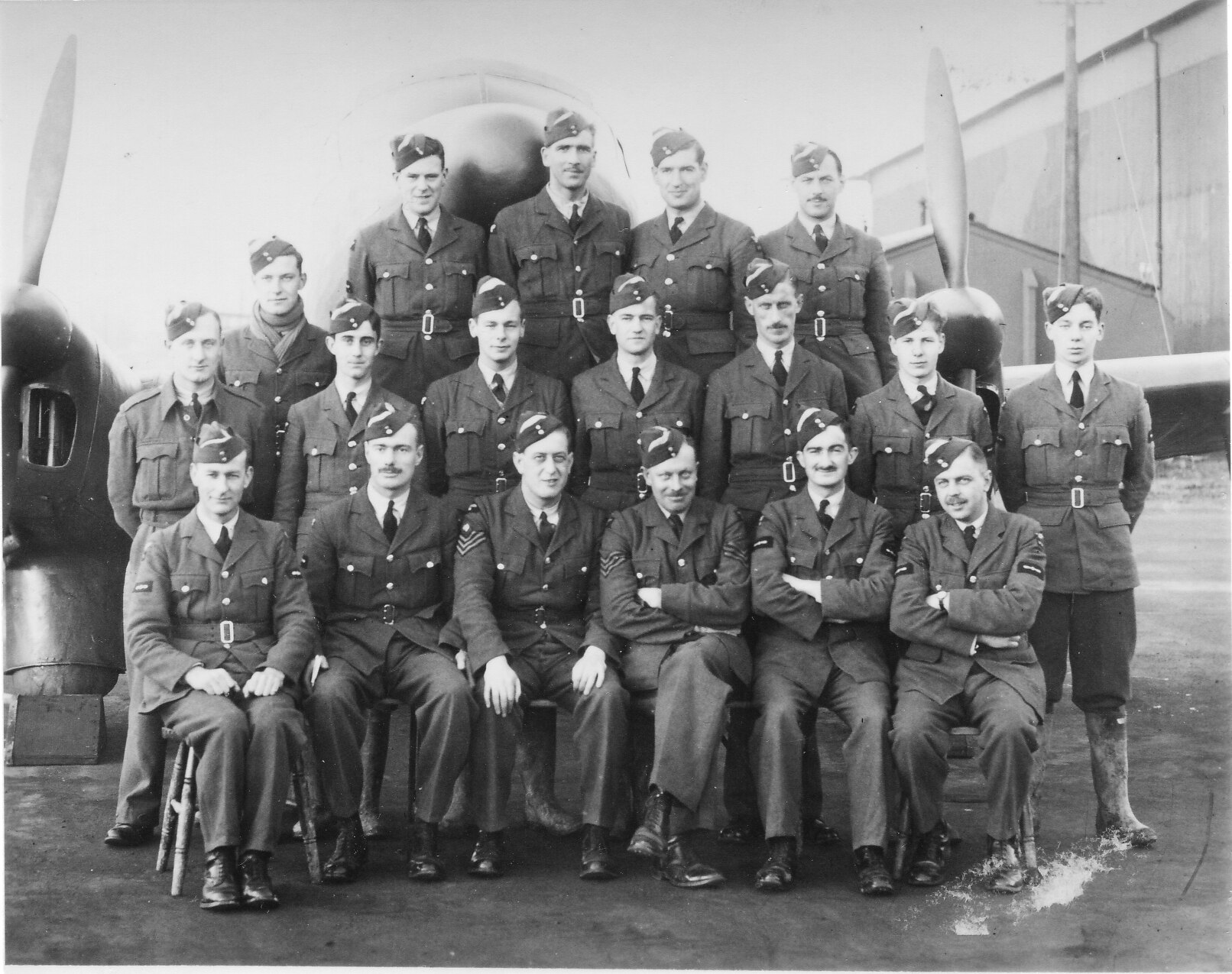
Twenty started the course but when this photograph was taken at Staverton in December 1941 there were only eighteen of us left.
Frank Thomson, standing at the right hand end of the middle row next to me, was a good friend. We had known each other at ITW and were to meet again at 410 Squadron. He did not survive the war.
I do not know what happened to the others in the picture.
Again I lived in a requisitioned hotel, this time in Cheltenham. We usually worked seven days a week and as a result whilst I was there I only saw Cheltenham a few times in daylight for we left for the airfield early in the morning and did not get back until after dark.
There were twenty of us and we knew we were on a shortened course, but nobody would, or could tell us what job we would be doing when we got onto operations. We were to study dead reckoning navigation but not astronavigation or bomb aiming.
I made my first flight the day after arriving. Feeling a little foolish walking about dressed in my flying clothing and parachute harness, and with an empty feeling in my stomach, I went out to the aircraft, got in and wondered whether I had made a mistake wanting to fly. All I was conscious of was the awful smell, a mixture of burnt rubber, dope and petrol fumes (I never did come across an RAF aircraft that had no smell). The aircraft, an Anson, took off and though the noise and vibration made me feel a bit apprehensive I was soon enjoying myself looking at what was happening below and trying to find where I was with my map.
The exercise for the pupils was map reading, but we were also supposed to be co-operating in an army exercise. This involved one of the pupils throwing a bucket of “poisonous gas” (coloured water) out of a window as the pilot dived on the soldiers below. Fortunately I was not the one doing the throwing for in the event all the water came back through the open window leaving the holder of the now empty bucket soaking wet.
The flight continued. A few minutes had gone by, when, suddenly, there was a tremendous bang, a gale was blowing inside the aircraft and there was debris everywhere. It entered my mind that the end had come, that we must be going to crash and that it had been a big mistake to want to fly! What had happened was that canvas on the top of the fuselage had ripped away, probably because it had rotted. The pilot did not seem too concerned so I went back to my map reading, keeping a watchful eye on the exposed structure of the aircraft just in case anything else broke. After my first flight I knew one thing: whenever I flew I was going to be worried that the aircraft I was in might not work properly. Subsequent experience proved that all too frequently something did go wrong.
Gradually I became accustomed to working in the air, putting into practice classroom lessons. Most of the pilots flying the school’s Ansons were Poles. Their attitude to flying was very casual and foolhardy. One of them was the cause of a tragedy that made me realise that flying was a very dangerous occupation. Several aircraft were lined up for take-off. The first one became airborne. Then the second went along the runway, lifted off and immediately the pilot put it into a steep climbing turn. Within seconds it had spun into the ground. It was our turn for take-off, which the pilot did without hesitation. I looked down in horror at the wreckage as we flew over all that was left of the aircraft. Next morning I was astounded that the school had not shut down for the day after so terrible a tragedy. I soon realised that the RAF did not mourn: everything went on as before, but in the classroom I grieved as I looked at the empty places of Ryalls and Mayo.
Another incident I can recall was a near disaster in fog. The aircraft were ready for take-off, with ours the first in line, but the fog was so thick that the pilot decided that rather than start the take-off run he would taxi along the runway to see what conditions were like. As the school’s aircraft had no radios this was a foolish thing to do for the next aircraft in line, believing that we had taken off, decided to do likewise. The pilot must have had a shock when he saw us ahead of him in the fog. He managed to heave his machine into the air and roared above us, but it was a very near thing.
My next move was to No. 3 Radio School at Prestwick where in January 1942 I spent some weeks in cold, dismal quarters, with inadequate food (we were convinced that the civilian caterers were taking our rations) and with snow on the ground for much of the time. Prestwick was reputed to have the longest and widest runway in the country, built to receive aircraft flying in from across the Atlantic. There was a blizzard which left the airfield snowbound. As it was imperative to reopen it quickly everyone was ordered out to clear the runway. There was no machinery for the job: we worked with shovels. Progress was slow but after two days a slight thaw set in and the shovels were put away.
The time came for all to be explained. We were taken to a hut, the door locked and a warning given that we must not reveal what we were about to be told. The secret was radiolocation (it was later in the war that the American name Radar was used) and we were given a brief explanation of what it was. I had never heard of it before, which shows how well a secret could be kept for thousands of people must have been in the know. Then we were told there was an even greater secret: the RAF’s nightfighters carried radiolocation equipment and it was this we were going to learn about, in due course becoming Radio Observers with brevets bearing the letters RO.
There was not a great deal of ground instruction for we were not being taught how the airborne interception equipment (known as AI) worked but only how to use it. There was an AI Mark IV set in the classroom on which it was possible to show blips on the CRTs (Cathode Ray Tubes) but a realistic interception could not be demonstrated. Nor could much be done in the air for the appalling weather and the poor state of most of the school’s Blenheim I aircraft meant that there was little flying. I only made four flights, just sufficient to get an idea of how to operate the set and to tell the pilot what to do to get behind the target aircraft.
The principle of AI Mark IV was simple. On one CRT, about 3 inches in diameter, appeared a blip from which the RO could judge whether the target was ahead or at what angle it was to port or starboard. On the other CRT a similar blip appeared showing the angle the target was above or below. The main limitation was imposed by the signal reflected from the ground which restricted the range of the set to the height of the aircraft. By watching the movements of the blips it was possible to determine relative courses and speeds. Throughout an interception the RO gave a running commentary and told the pilot what changes to make in course, height and speed. Finally, having closed to visual distance, the RO could tell the pilot where to look for the target.
There were some odd characters in the RAF. One of the school’s pilots was reputed to be mad: to enliven what to him must have been very boring flights he made a habit of going to a nearby balloon barrage then taking his aircraft through it, just beneath the balloons. He was still alive when I left the school! At Aberystwyth there was an instructor, a corporal who had been an air gunner, and he spent his time telling us in great detail about the nasty things that Arab ladies did to airmen who crashed in the desert. We were convinced he had been one of these unfortunates but he never offered to display the evidence to either prove or refute this.
I left Prestwick to spend a week in Edinburgh with my grandfather and his sister before going home on leave to await a telegram ordering me to report to an OTU (Operational Training Unit). I had time on my hands so I managed to do a lot of walking and cycling on Dartmoor, a desolate and lonely place in a wartime winter. The telegram came and I was instructed to report to No. 51 OTU at Cranfield near Bedford. I arrived there on 31 March 1942 and was promoted to be a Sergeant and given my RO’s flying brevet.
Editor’s notes
These notes were added in 2026 and are not part of E G White’s text. They summarise information from the Wikipedia articles linked at the end of each note. See About this edition and the glossary of RAF terms.
No. 6 Air Observers Navigation School was based at Staverton, an RAF training station since 1936, from November 1939 until January 1942; the airfield is now Gloucestershire Airport. Prestwick, where he went next, was the RAF’s control point for transatlantic flights during the war.
The secret revealed to him there, AI Mark IV, was the world’s first operational air-to-air radar. Early sets flew in converted Blenheims in July 1940 and the definitive Mark IV was widely available on the Beaufighter by early 1941, where it is credited with a part in ending the Blitz. It worked on a wavelength of 1.5 metres and could detect a large aircraft at up to 20,000 feet, but its maximum range was limited by the aircraft’s own height and its minimum range was barely close enough for the pilot to see the target; interpreting its two cathode-ray tubes demanded considerable skill from the operator. Centimetric sets began replacing it from the end of 1941, and by 1943 the Mark IV had largely been relegated to second-line duties.
Source: RAF Staverton, Glasgow Prestwick Airport, AI Mark IV radar (Wikipedia).
Aircraft in this chapter

Avro Anson
Anson Mk I
- A British twin-engined multi-role aircraft built by Avro, developed in the mid-1930s from the Avro 652 airliner to meet an Air Ministry requirement for a coastal reconnaissance landplane.
- The prototype first flew on 24 March 1935 and the type entered RAF service in the maritime reconnaissance role.
- It was obsolete as a front-line combat aircraft by the outbreak of the Second World War and became one of the principal multi-engine aircrew trainers of the British Commonwealth Air Training Plan, which is how E G White met it at No. 6 AONS and later as an instructor at No. 62 OTU.
- By the end of production in 1952 Avro had built 8,138 Ansons, with a further 2,882 built in Canada.
- The Anson remained in RAF service as a trainer and communications aircraft until 28 June 1968.
Source: Avro Anson (Wikipedia).